The Comfortable Consensus: How Prosperous Societies Learn to Misread Their Own Decline
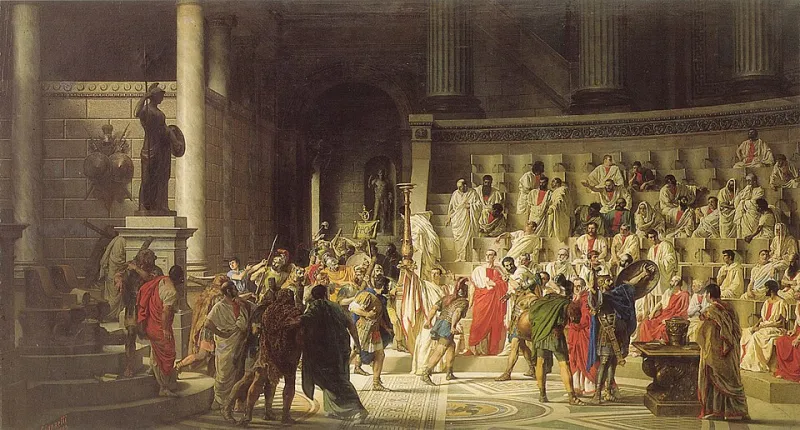
Photo: Raffaele Giannetti, CC0, via Wikimedia Commons
Decline rarely announces itself. It does not send a herald or post a notice. It moves through institutions gradually, accumulating in the places that are least visible to the people whose comfort depends on not looking too carefully. And when the evidence eventually becomes impossible to ignore, the standard response from those who were most positioned to see it earliest is some version of the same claim: nobody could have known.
The record suggests otherwise.
The Structure of Coordinated Reassurance
The late Western Roman Empire is the canonical case, and it is worth examining not as a story of barbarian pressure or military overextension—both of which are real—but as a story of how the senatorial class processed information about structural deterioration.
By the fourth century, the tax base was contracting. Agricultural land in the Italian heartland was being consolidated by large estate holders who had the political influence to negotiate favorable assessments. The currency had been debased repeatedly. Military recruitment increasingly depended on federated troops whose loyalty was contractual rather than civic. None of this was secret. Roman administrators wrote about it. Historians documented it. The evidence existed in the public record.
What also existed was a remarkable cultural apparatus dedicated to the proposition that Rome was eternal. The rhetoric of imperishability was not merely propaganda—it was a genuine cognitive framework through which educated Romans processed contradictory information. When the evidence of decline appeared, it was interpreted not as a systemic signal but as a temporary deviation from a permanent condition. The assumption of continuity was so deeply embedded that it functioned as a fact, overriding observations that should have disturbed it.
This is what coordinated reassurance looks like from the inside. It does not require conspiracy. It requires only that the people who share a comfortable interpretation of events also share the social networks, the professional incentives, and the cultural assumptions that make that interpretation feel like common sense.
Who Benefits From the Quiet Reading
The key insight from the historical record is not that elites are uniquely dishonest. It is that they are uniquely positioned to benefit from optimistic interpretations of ambiguous data—and that this positioning shapes what they perceive as reasonable.
The Ming dynasty's fiscal crisis in the seventeenth century developed over decades. The land registration system that formed the tax base had been corrupted gradually, through a combination of local administrator fraud and the political influence of gentry families who had strong incentives to underreport holdings. The central government's revenue figures were increasingly fictional, a fact that was known to the people producing the figures and, at some level, to the officials receiving them.
But the gentry class that benefited from the undercounting was also the class that staffed the bureaucracy, wrote the policy analyses, and formed the intellectual consensus about the dynasty's condition. Their assessment, consistently, was that the system was functioning within acceptable parameters and that the problems being identified were manageable with modest reform. They were wrong. The dynasty collapsed in 1644 under the combined pressure of fiscal exhaustion, military failure, and a famine it could no longer afford to address.
The pattern is not unique to China or to Rome. It appears in the correspondence of Bourbon court officials in the decades before 1789, in the parliamentary debates of the Ottoman reform era, in the board minutes of American financial institutions in the years before 2008. The comfortable consensus is not a feature of any particular culture. It is a feature of any situation in which the people most capable of generating and interpreting structural data are also the people most exposed to the consequences of an alarming interpretation.
The Technology of Normalization
Every civilization develops specific tools for converting alarming signals into background noise. These tools are worth examining because they are not crude—they are sophisticated, and they often incorporate genuine intellectual effort.
The most durable of these tools is the comparison class problem. When an official in a declining system is confronted with evidence of deterioration, the natural response is to identify a reference point that makes the current situation look acceptable. Roman administrators in the fourth century compared their circumstances not to the peak of the second century but to the chaos of the third-century crisis, against which almost anything looked like stability. This is not irrational—it is a reasonable use of historical context. But it is also a mechanism that systematically produces optimistic assessments of situations that would look alarming if measured against a more demanding standard.
A second tool is the attribution of structural problems to contingent causes. When revenue falls, the explanation is a bad harvest, not a broken tax system. When military recruitment fails, the explanation is a specific commander's mismanagement, not a systemic erosion of the civic culture that produced soldiers. This attribution pattern allows each individual symptom to be addressed as a discrete problem while the underlying condition continues to develop. It is intellectually coherent at the level of each individual case and catastrophically misleading at the level of the pattern.
The American Context
For readers accustomed to thinking about these dynamics in domestic terms, the American version of the comfortable consensus has its own characteristics. The ideological commitment to systemic resilience—the belief that American institutions are self-correcting by design—functions in much the same way that Roman imperishability rhetoric functioned: as a prior assumption that makes structural deterioration difficult to perceive as such.
This is not a partisan observation. The comfortable consensus in the United States has been maintained by successive administrations, by financial institutions, by media organizations, and by academic frameworks that have consistently found ways to interpret evidence of structural stress as evidence of temporary deviation. The savings and loan crisis, the dot-com collapse, the 2008 financial crisis, and the COVID-19 response failures all share a common feature: the structural conditions that produced them were visible in advance to people who were professionally and institutionally incentivized to interpret them as manageable.
What the Pattern Does Not Excuse
It would be convenient to conclude that the comfortable consensus is simply a natural feature of human cognition and that its persistence across history means it cannot be resisted. The record does not fully support this conclusion.
There are documented cases of elites who correctly identified systemic problems, communicated them accurately, and generated institutional responses that mitigated the damage. The cases are less common than the failure cases, which is precisely why they are worth studying. What they share, in most instances, is not superior intelligence or moral virtue. They share an institutional structure in which the cost of accurate pessimism was lower than usual—in which the messenger was protected, the analysis was genuinely separated from the interests of the people commissioning it, and the decision-making process included people with incentives that diverged from the comfortable consensus.
History does not suggest that denial is destiny. It suggests that denial is the default—and that departing from it requires deliberate institutional design rather than the hope that the right people will eventually say the right things at the right moment.