Being Sent to Europe to Become Civilized: The Grand Tour's Promise, Its Failures, and Why You Should Go Anyway
Being Sent to Europe to Become Civilized: The Grand Tour's Promise, Its Failures, and Why You Should Go Anyway
Somewhere between the boarding gate and the first espresso, something happens to Americans in Europe. The posture changes. The voice drops slightly. There is a new and careful attention to whether one is eating at the right hour, sitting at the right café, ordering in a way that will not mark one as irredeemably provincial. This anxiety — cultured, aspirational, faintly embarrassing — has a history. It is older than the airplane, older than the package tour, older than the American passport itself. It dates, in a fairly direct line, to an educational institution that flourished among the British and American elite between roughly 1660 and 1840, and that was called, with characteristic straightforwardness, the Grand Tour.
The Grand Tour was, in its formal conception, a curriculum. It was the final stage of a gentleman's education: after Oxford or Cambridge, a young man of means would spend anywhere from several months to several years traveling through France, Italy, and sometimes Greece, accompanied by a tutor, absorbing art and antiquity and the manners of continental courts. The theory was explicit: exposure to the physical evidence of great civilizations would produce men of broader judgment, finer taste, and more sophisticated political understanding. Europe was the classroom. Old things were the lesson plan.
The theory was not entirely wrong. The problem was the students.
What the Grand Tourists Actually Did
The historical record of the Grand Tour is voluminous and frequently unflattering. Grand Tourists commissioned portraits of themselves in front of the Colosseum. They purchased enormous quantities of classical sculpture, some of it genuine and much of it not. They wrote letters home describing their refined appreciation for Raphael and then spent their evenings gambling and pursuing local liaisons of varying propriety. Their tutors, hired to provide intellectual structure, were largely ignored once the party reached Paris.
James Boswell, whose European travels in the 1760s are among the most candid accounts of the Grand Tour experience, is a useful case study. Boswell genuinely engaged with the intellectual content of his travels — he sought out Rousseau, spent time with Voltaire, and made a serious effort to understand the political situation in Corsica. He also documented his own moral failures with a frankness that would be remarkable in any era. The Tour, for Boswell, was genuinely educational. It was also a prolonged exercise in the gap between aspiration and behavior that characterizes most educational experiences, formal or otherwise.
The graduates of the Grand Tour returned home with Italian paintings, classical busts, and an elaborate vocabulary for describing aesthetic experiences they may or may not have actually had. They built country houses in the Palladian style. They quoted Horace in parliamentary debates. They established the cultural infrastructure of Anglo-American taste — the museums, the architectural traditions, the conviction that a certain category of European experience confers a certain category of authority — that persists, in modified form, to this day.
What Was Actually Learned
Here is the uncomfortable truth about the Grand Tour, and about educational travel more broadly: the learning that stuck was almost never the learning that was intended. The young men sent to absorb classical civilization mostly absorbed something more diffuse and more durable — a felt sense of historical scale, an embodied understanding that the world was older and stranger than their domestic experience had suggested, and a lasting unease with their own provincialism.
This is not nothing. It is, in fact, quite a lot. The problem was the frame placed around it: the insistence that the Tour produced cultured gentlemen, that the aesthetic vocabulary acquired in Florence was evidence of genuine refinement, that the ability to discourse knowledgeably about ancient ruins was equivalent to having internalized what those ruins meant. The credential was mistaken for the education.
Human psychology has not changed since the seventeenth century. The student who returns from a semester abroad having acquired a facility with local coffee customs and a collection of photographs in front of famous buildings, while claiming to have been transformed by the experience, is the direct descendant of the Grand Tourist who came home with a Canaletto and a speech about the sublime. The performance of having been educated by travel is considerably easier to produce than the education itself.
Why Americans Still Feel Small in European Cities
The vague inferiority that many Americans experience in Rome or Paris or Athens is not, at its root, about sophistication or cultural knowledge. It is about scale and time. The United States is a young country in a physical sense — its oldest buildings are recent by European standards, its cities do not carry the accumulated visual weight of centuries of continuous habitation. Standing in a medieval piazza or walking through a Roman forum, an American is confronted with evidence that human civilization has been running this experiment for a very long time, and that the chapter in which America appears is a recent one.
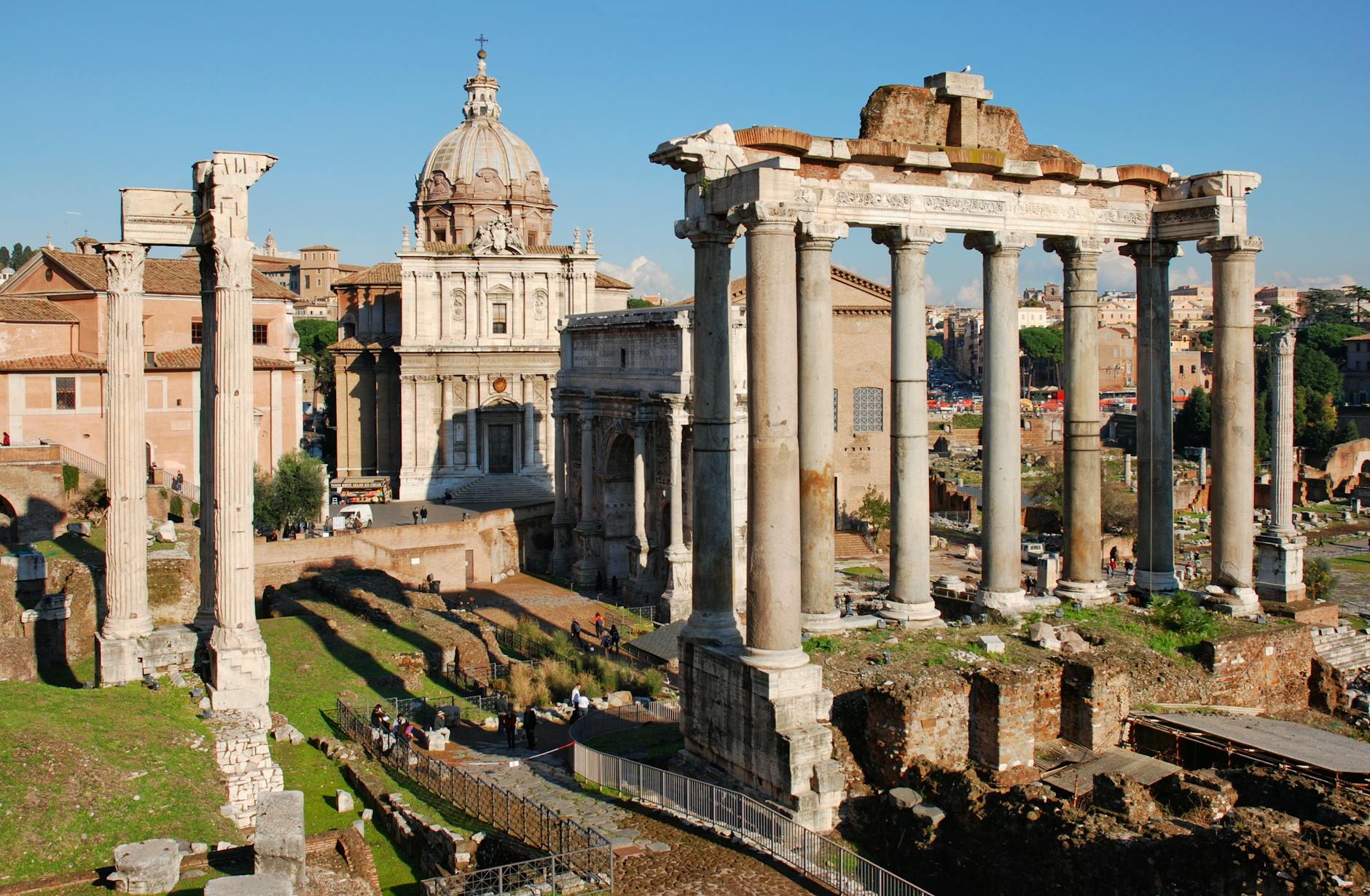
This confrontation is productive if you let it be. It is the same confrontation the Grand Tourists experienced, beneath all their posturing. The ruins of Rome do not make you feel small because you are ignorant of Roman history. They make you feel small because they are evidence of something genuinely larger than any individual life or any national story — the sheer duration of the human project, the accumulation of ambition and failure and reinvention across thousands of years.
The Grand Tour's most honest graduates understood this. Edward Gibbon, sitting among the ruins of the Capitol in Rome in 1764, was struck by a thought that became The Decline and Fall of the Roman Empire — one of the most significant historical works in the English language. The ruins did not teach him Roman history. They gave him a question large enough to spend a lifetime answering.
The Case for Treating Travel as a Curriculum
The Grand Tour was exclusive by design — accessible only to those with the wealth and leisure to spend years abroad. The democratization of international travel has made the physical experience available to far more people without necessarily democratizing the intellectual framework that made the Tour, at its best, genuinely educational.
The practical argument for approaching European travel as a curriculum rather than a checklist is not about elitism. It is about return on investment in the most literal sense. A week in Rome spent ticking monuments off a list produces photographs and fatigue. A week spent with a specific question — about how urban spaces shape political culture, about how societies absorb catastrophic failure and rebuild, about what architectural choices reveal about the values of the people who made them — produces something that persists after the jet lag clears.
You do not need a tutor or a trust fund. You need a question. The old world has been running the human experiment long enough to have data on almost anything you want to understand. The ruins are not decorative. They are primary sources. Treat them accordingly, and the vague inferiority dissolves into something more useful: the recognition that you are standing inside a very long story, and that understanding your own moment requires knowing the chapters that came before it.
The Grand Tour graduates who came home changed were not the ones who saw the most. They were the ones who arrived with enough intellectual curiosity to let the old world ask them something back.