Rulers Have Been Blindsided by Inflation Since Before the Dollar Existed — A History for the Financially Anxious
Rulers Have Been Blindsided by Inflation Since Before the Dollar Existed — A History for the Financially Anxious
If you have spent any time recently watching financial news, reading economics commentary, or simply existing as an American who buys groceries, you have probably encountered some version of the following sentiment: that the inflationary pressures of the current moment are unprecedented, that the tools available to address them are untested, and that we are navigating genuinely new economic territory. This sentiment is understandable. It is also, viewed against the full length of recorded human history, almost comically wrong.
Inflation is not a modern invention. Monetary crisis is not a product of the Federal Reserve, the gold standard's abandonment, or any other feature of contemporary economic architecture. It is among the oldest and most reliably recurring phenomena in the history of organized civilization — and the most consistent feature of every inflationary episode across five thousand years of records is that the people experiencing it were convinced it had never happened before.
This is a guide for the financially anxious. It will not tell you what the market will do. No honest source can do that. What it can do is place your anxiety inside a longer story — one in which the ending is not always reassuring, but in which the patterns are at least legible.
Diocletian's Edict, or: What Happens When You Command Prices to Stop
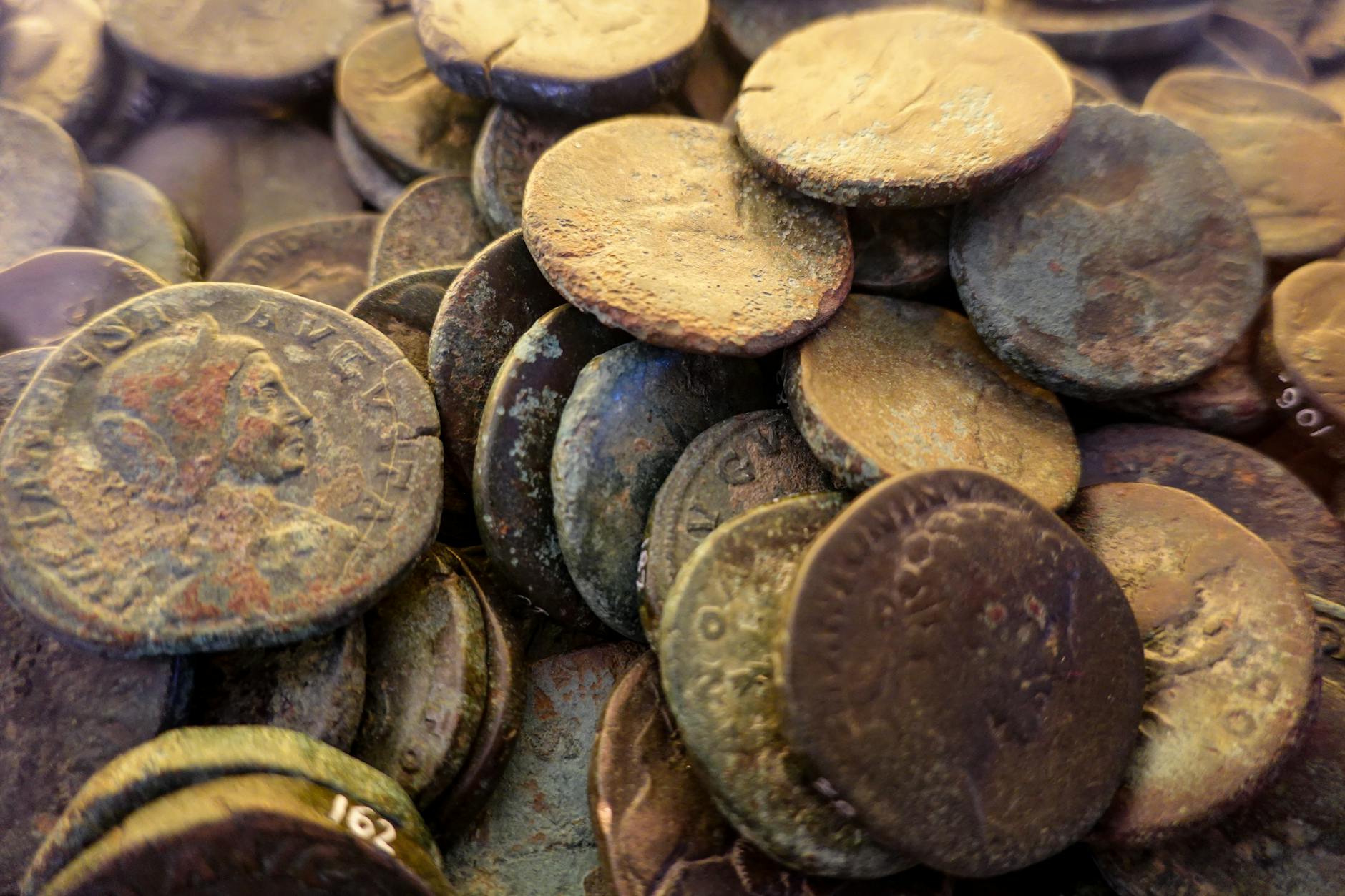
In 301 AD, the Roman Emperor Diocletian issued the Edictum De Pretiis Rerum Venalium — the Edict on Maximum Prices — in response to an inflationary crisis that had been building for decades. The Roman government had been debasing its currency since at least the reign of Nero, steadily reducing the silver content of the denarius to fund military campaigns and imperial administration. By Diocletian's time, the denarius contained perhaps two percent of the silver it had held two centuries earlier. Prices had responded accordingly.
Diocletian's solution was to make high prices illegal. The edict set maximum prices for hundreds of goods and services, from wheat and wine to the wages of a scribe or a sewer cleaner. Merchants who charged more were subject to execution. The edict's preamble blamed the crisis not on monetary debasement — which Diocletian's own government had continued — but on the greed of traders and speculators who were, in his framing, exploiting honest Romans.
The edict failed almost immediately. Merchants simply stopped selling goods at prices that guaranteed losses. Shortages followed. The black market expanded. Within a few years the price controls were quietly abandoned, having accomplished nothing except to demonstrate that the relationship between money supply and prices is not a matter of imperial preference.
What is striking about this episode is not the failure. Price controls have failed in nearly every context in which they have been attempted, and economists across the ideological spectrum largely agree on why. What is striking is the preamble — the insistence that the crisis was caused by bad actors rather than by the government's own monetary choices, and the apparent genuine belief that a sufficiently forceful decree could override economic reality. Diocletian was not stupid. He was operating exactly as human psychology operates when confronted with a complex systemic problem: he found a visible villain, assigned blame, and issued a command.
The Ming Dynasty and the Paper Tiger
China's Ming Dynasty provides a different chapter of the same story, and one with particular relevance to any modern economy that relies on fiat currency — which is to say, every modern economy.
The Ming government inherited from its predecessors the concept of paper money, which Chinese authorities had been experimenting with since the Tang Dynasty. Early Ming paper currency, the Da Ming Baochao, was initially backed by reserves and circulated with reasonable stability. As the dynasty's fiscal pressures mounted — military campaigns, natural disasters, the enormous cost of constructing and maintaining the Forbidden City — the government did what governments under fiscal pressure reliably do: it printed more money without a corresponding increase in the underlying reserves.
The result was a centuries-long inflationary spiral that progressively destroyed confidence in the currency. By the late Ming period, paper money had become so devalued that the government itself largely stopped accepting it for tax payments, effectively acknowledging that its own currency was worthless. The dynasty that followed, the Qing, largely abandoned paper money for silver — a monetary reset that required the complete collapse of the previous system to accomplish.
The Ming experience illustrates a pattern that recurs across monetary history: the gap between the moment when a government's monetary choices become unsustainable and the moment when that unsustainability becomes undeniable is often measured in generations. The people living through the early stages of a currency's debasement frequently do not recognize it as such. The people living through the final stages often cannot believe it was not obvious all along.
Weimar and the Seduction of "Special Circumstances"
Weimar Germany's hyperinflation of the early 1920s is the episode most familiar to American audiences, partly because its imagery — the famous photographs of Germans pushing wheelbarrows of banknotes to buy bread — is so viscerally dramatic. But the Weimar case is instructive less for its extremity than for the thinking that preceded it.
German economists and government officials in the years immediately following World War One had access to the historical record. They knew about Rome. They knew about the monetary crises of the early modern period. Many of them argued, with considerable sophistication, that Germany's situation was different — that the inflationary pressure was a temporary consequence of war reparations and foreign speculation, that once those external pressures were resolved, stability would return without requiring painful monetary discipline.
This was not ignorance. It was the entirely human tendency to classify one's own crisis as an exception to the rules that governed everyone else's. The Weimar hyperinflation accelerated anyway, destroying the savings of the German middle class and contributing to the political instability that followed.
What the Pattern Means for the Present
None of this is to suggest that contemporary American inflation is equivalent to Weimar Germany, or that the dollar is the denarius. Context matters enormously, and the specific mechanisms of modern monetary policy differ in important ways from those available to Diocletian or the Ming court.
What does not differ is the psychology. The belief that the current inflationary moment is historically unprecedented — that the old rules do not apply, that this time the causes are uniquely structural, uniquely political, uniquely the result of forces that have never combined in quite this way before — is not an insight. It is a recurring feature of every monetary crisis in the historical record. It is what people say every time.
The financially anxious American does not need to become a monetary historian to find this useful. The practical takeaway is simpler: when official explanations for an economic crisis emphasize its novelty and uniqueness, treat that emphasis as a flag rather than a reassurance. The longest human experiment suggests that monetary crises follow patterns, that those patterns are legible in advance, and that the leaders who manage them worst are almost always the ones most convinced they are navigating unprecedented territory.
Panic with context is still panic. But it is more honest than panic dressed up as informed confidence.