The Oldest Playbook in Politics: How Rome's Spin Doctors Wrote the Rules We Still Follow
The Oldest Playbook in Politics: How Rome's Spin Doctors Wrote the Rules We Still Follow
There is a temptation, when surveying the wreckage of modern political discourse, to conclude that something has gone uniquely, perhaps irreparably, wrong with the present age. The forged documents, the strategically timed leaks, the whisper campaigns designed to reach just the right ears — surely this is a product of our fractured media environment, our algorithmic outrage machines, our particular moment of civilizational stress.
Rome would like a word.
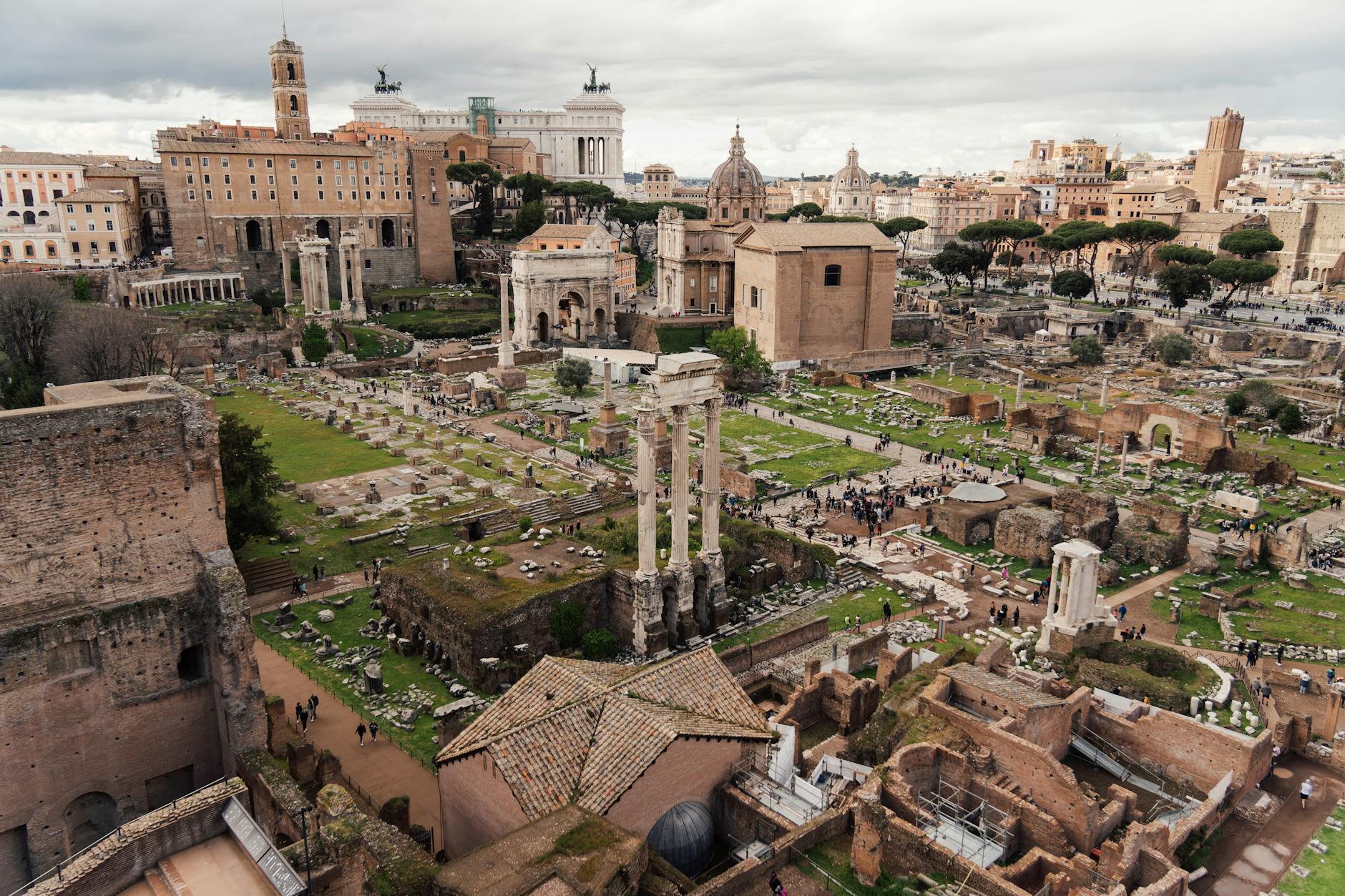
The late Roman Republic, in the final century before the common era, was a society drowning in deliberate misinformation. The mechanisms were slower — no fiber-optic cables, no viral shares — but the underlying psychology was identical. Factions spread false rumors through the Forum. Letters were forged and then "discovered" at convenient moments. Public speakers shaped narratives not to inform but to destroy. If you want to understand how disinformation actually works, you do not need a media studies degree. You need Suetonius, Plutarch, and a quiet afternoon.
The Information Ecosystem of the Late Republic
Rome's public sphere functioned through a surprisingly sophisticated network of communication. The acta diurna — a kind of proto-newspaper posted in public spaces — carried official announcements. Slaves and freedmen served as information brokers, carrying gossip between aristocratic households. Speeches in the Forum were transcribed and circulated. Letters traveled across the empire with remarkable speed.
This was not a primitive system. It was a complex, multi-layered media environment with competing outlets, partisan actors, and audiences hungry for sensation. Sound familiar?
Into this environment stepped men who understood, with ruthless clarity, that perception was power. The late Republic's factional struggles — optimates versus populares, old money versus new ambition — were fought as much on the terrain of public opinion as on any battlefield. And the weapons of choice were informational.
Cicero, Caesar, and the Art of the Smear
Marcus Tullius Cicero is remembered today as Rome's greatest orator, a defender of the Republic, a man of principle. He was also one of antiquity's most gifted propagandists, and he knew it.
When Cicero delivered his Philippics against Mark Antony — fourteen speeches across roughly a year, from 44 to 43 BCE — he was not simply making legal arguments. He was conducting a sustained campaign of character assassination. He accused Antony of drunkenness, sexual depravity, financial corruption, and treasonous intent, often with thin or fabricated evidence. The goal was not to win a debate. The goal was to make Antony's name synonymous with disgrace before the Roman public could form an independent judgment.
Cicero's letters to his friend Atticus — private correspondence that survived, to Cicero's probable posthumous embarrassment — reveal a man who was acutely aware of how narratives were constructed and who was not above constructing them strategically. He understood that a rumor, repeated with confidence by a credible source, could harden into accepted fact within days.
Caesar's faction was no cleaner. The Commentarii de Bello Gallico — Caesar's own account of his Gallic campaigns — is a masterwork of self-serving narrative, written in the third person to project an air of objectivity while systematically glorifying Caesar's judgment and minimizing his failures. It was distributed in Rome while Caesar was still in the field, explicitly designed to shape public and senatorial opinion back home. It was, in the most precise sense of the term, content marketing.
Both men understood something that modern political operatives rediscover every election cycle: the first version of a story is the most powerful. Corrections and rebuttals arrive too late, to smaller audiences, with less emotional force.
Forged Letters and Convenient Leaks
The Republic's disinformation ecosystem went beyond rhetoric. Physical documents were fabricated with some regularity. During the Catilinarian conspiracy of 63 BCE — the crisis that gave Cicero his greatest political triumph — letters purportedly from the conspirators were produced as evidence before the Senate. Historians have debated their authenticity for centuries. What is not debated is that Cicero's political career depended on their being believed, and that he presented them in a manner designed to foreclose skepticism.
Similarly, the period surrounding Caesar's assassination in 44 BCE saw a torrent of forged documents. Antony was accused of producing fake entries in Caesar's notebooks to authorize policies and appointments Caesar had never actually approved. His opponents claimed he was essentially writing legislation and attributing it to a dead man. Whether or not every accusation was accurate, the tactic — using a document of uncertain provenance to advance a political agenda — was sufficiently common that contemporaries treated it as unremarkable.
The machinery was different. The logic was not.
Why the Playbook Never Goes Out of Date
Here is the uncomfortable truth that history keeps delivering: disinformation is not a bug in political systems. It is a predictable feature of any environment where information shapes power and where the cost of lying is lower than the benefit of winning.
The Roman senators who spread false rumors about their rivals were not uniquely corrupt men. They were ordinary human beings operating in a high-stakes competitive environment, using every available tool. The same calculus appears in the pamphlet wars of the American Revolution, in the yellow journalism of the 1890s, in the propaganda ministries of the twentieth century, and in the social media ecosystems of today.
This is not a warning from history. History is not issuing warnings. It is simply keeping records — two thousand years of documentation showing that human beings, when political survival is on the line, behave in remarkably consistent ways.
The Roman Senate did not invent disinformation. Neither did we. We inherited it, as every generation has, from the one before — along with the Forum debates, the forged letters, the strategically timed leaks, and the absolute conviction, shared by every faction in every era, that their side's version of events is the truthful one.
Cicero believed that, too. Right up until Antony's soldiers caught up with him on a road in southern Italy in December of 43 BCE.
The spin, it turned out, had not been enough.