The Republic That Refused to Die
In 1797, when Napoleon finally dissolved the Venetian Republic, he was ending a political entity that had survived for 1,100 years. More remarkably, he was ending a state that had spent roughly eight of those eleven centuries in what any reasonable observer would have called terminal decline. Venice had been written off by contemporary analysts during the Ottoman expansion of the fifteenth century, the Portuguese circumnavigation of Africa in the sixteenth century, the Thirty Years' War in the seventeenth century, and the rise of Atlantic commerce in the eighteenth century.
Each time, Venice was supposed to collapse. Each time, it adapted instead.
The secret wasn't that Venice avoided existential crises—it was that Venice became extraordinarily good at managing them. While other states built their institutions around assumptions of stability and growth, Venice constructed its entire political and economic system around the expectation of perpetual emergency. The result was a civilization that treated crisis not as an exception to be weathered, but as the normal state of affairs to be institutionally managed.
For American readers watching democratic institutions strain under contemporary pressures, Venice offers something more valuable than inspiration. It provides a manual for how complex societies can function when everything is always falling apart.
The Technology of Redundancy
Venice's genius lay in building systematic redundancy into every aspect of governance. The Doge was the head of state, but his power was checked by the Council of Ten, which was balanced by the Senate, which was constrained by the Great Council, which was monitored by a rotating series of oversight committees with deliberately overlapping jurisdictions. No single institution could paralyze the system, because every critical function was distributed across multiple bodies.
This wasn't elegant—Venetian government was famously bureaucratic and slow. But it was antifragile. When the Ottoman Empire cut off traditional Eastern trade routes in the fifteenth century, Venice didn't need to reinvent its entire economy. It simply activated alternative commercial networks that had been maintained for exactly this contingency. When plague devastated the city in 1630, killing a third of the population, the government continued functioning because every essential role was filled by multiple people who could substitute for each other.
The Venetians understood something that most political theorists miss: in genuinely dangerous environments, efficiency is a luxury you can't afford. Better to have five people who can do a job adequately than one person who can do it perfectly. When that perfect person dies, gets corrupted, or makes a catastrophic mistake, the system continues operating.
The Economics of Uncertainty
Venetian commercial law was built around the assumption that most ventures would fail. Rather than trying to prevent failure, merchants developed sophisticated methods for distributing risk across multiple investors, multiple ships, and multiple trade routes. The colleganza system allowed investors to fund voyages without putting their entire fortunes at stake, while shipowners could finance expeditions without risking bankruptcy from a single loss.
This approach created what modern economists would recognize as a remarkably sophisticated capital market—not because Venetians were trying to maximize returns, but because they were trying to minimize the probability of total loss. Venetian merchants became wealthy not by making brilliant bets, but by making hundreds of small bets that could survive multiple failures.
The psychological impact was profound. While other commercial centers boom and bust with market cycles, Venice maintained steady growth for centuries because its economic system was designed to function during crises rather than despite them. Venetian merchants didn't panic when trade routes closed or wars disrupted commerce—they activated backup plans that had been prepared generations in advance.
The Diplomatic Revolution
Venice pioneered modern diplomacy not from idealism but from necessity. Surrounded by larger, more powerful neighbors, the Republic couldn't survive through military strength alone. Instead, Venetian diplomats developed the art of playing enemies against each other while avoiding permanent commitments to any side.
This required institutional memory that extended far beyond any individual diplomat's career. Venice maintained detailed records of every negotiation, every treaty, every broken promise, and every successful deception going back centuries. New ambassadors inherited not just their portfolios, but comprehensive intelligence files that allowed them to understand the long-term patterns in their counterparts' behavior.
The system worked because it was designed to outlast the people who operated it. Individual Venetian diplomats might be brilliant or mediocre, honest or corrupt, but the institutional knowledge they accessed was accumulated over generations and designed to survive any particular person's limitations.
The American Mirror
Contemporary America faces remarkably similar challenges to those that defined Venetian politics for eight centuries. Like Venice, America is a commercial republic surrounded by larger land-based powers. Like Venice, American prosperity depends on maintaining complex international networks that are constantly threatened by hostile forces. And like Venice, America must navigate between the demands of democratic governance and the necessities of great power competition.
The Venetian model suggests that the key to long-term survival isn't solving these contradictions but institutionalizing the capacity to manage them. This means building redundancy into critical systems, distributing risk across multiple institutions, and maintaining institutional memory that extends beyond electoral cycles.
Most importantly, it means accepting that crisis is the normal state of affairs for any complex civilization. Venice survived for eleven centuries not because it avoided existential threats, but because it built its entire system around the assumption that existential threats were permanent features of the political landscape.
The Lesson in Salt Water
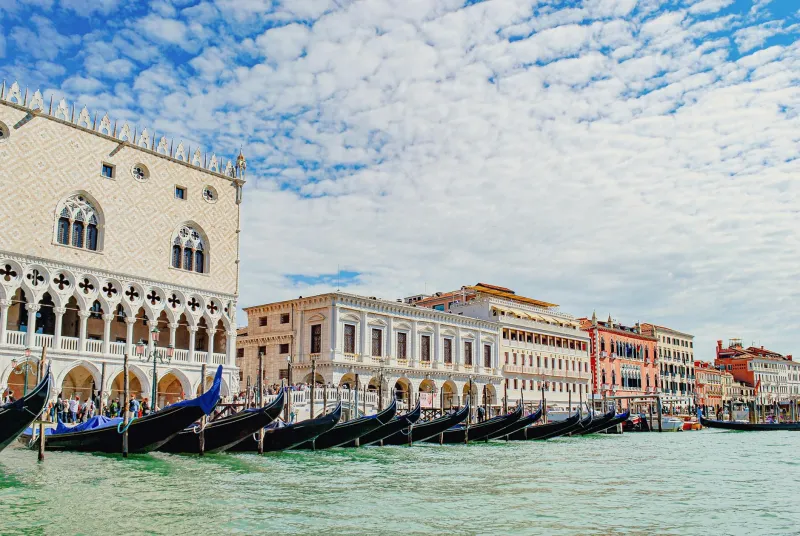
When modern visitors walk through Venice, they see a museum city sustained by tourism and nostalgia. But the buildings they're admiring were constructed by a civilization that spent eight centuries convinced it was about to collapse. The palaces on the Grand Canal were built during Ottoman expansion. The churches were erected during plague years. The commercial infrastructure was developed while Portuguese navigators were destroying Venice's monopoly on Eastern trade.
Every generation of Venetians believed they were witnessing the end of their world. They were usually right about the magnitude of the challenges they faced. They were wrong about their capacity to adapt to them.
The Republic finally fell not because it faced an insurmountable crisis—it had survived worse threats than Napoleon. It fell because by 1797, Venetians had forgotten how to believe in their own system. The institutional mechanisms that had sustained the Republic through eight centuries of emergencies were still functional, but the political will to operate them had atrophied.
This suggests the most important lesson Venice offers to contemporary democracies: the greatest threat to any system isn't external pressure or internal contradiction, but the loss of confidence in the system's ability to handle whatever comes next. Venice survived as long as Venetians believed Venice could survive. When that belief disappeared, so did the Republic.
The lagoon is still there. The buildings still stand. The commercial networks that connected East and West for a millennium have been replaced by container ships and fiber optic cables, but the fundamental challenge remains the same: how do complex societies maintain themselves when everything is always changing and nothing is ever certain?
Venice spent eleven centuries proving it could be done. Whether contemporary democracies can learn from their example may determine whether our own institutions survive the next century's inevitable crises.