When Losing Looked Like Winning: The Ancient Art of Rewriting Military Disaster
The Pharaoh's Impossible Victory
In 1274 BCE, Pharaoh Ramesses II led his army into what military historians now recognize as one of ancient Egypt's most dangerous miscalculations. At Kadesh, in modern Syria, Egyptian forces walked straight into a Hittite trap that nearly cost them their king and could have ended the empire's expansion into the Levant. Ramesses barely escaped with his life, his army scattered, and the strategic objectives completely unmet.
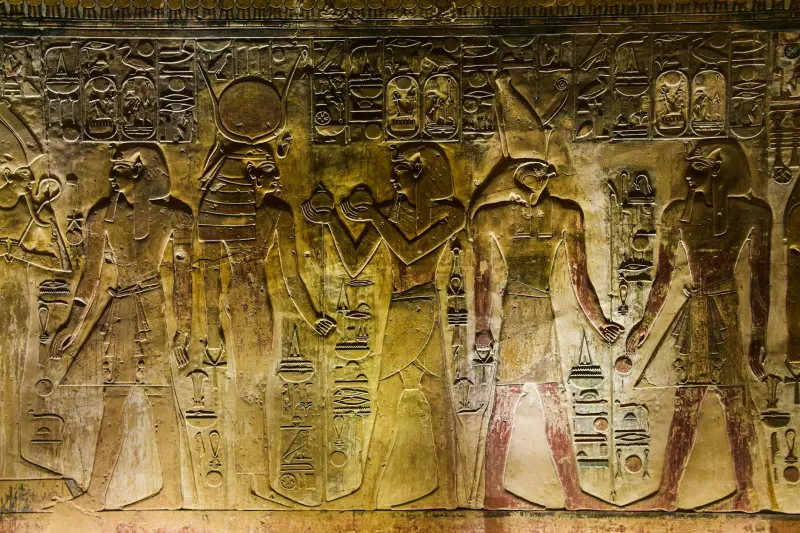
Yet if you visited Egypt's temples today, you'd encounter a different story entirely. Carved across the walls of Abu Simbel, Karnak, and half a dozen other sacred sites, Ramesses appears as the lone hero who single-handedly routed the entire Hittite army. The pharaoh charges through enemy lines like an ancient Rambo, his chariot wheels crushing fallen enemies while divine light radiates from his crown. The Battle of Kadesh became, in official Egyptian memory, the greatest military triumph in the kingdom's history.
This wasn't accidental mythology. It was calculated information warfare, executed with the same systematic precision we see in modern political campaigns. The gap between what happened at Kadesh and what Egyptians were told about Kadesh reveals something fundamental about how power has always protected itself: reality is negotiable, but only if you control the narrative machinery.
The Roman Recipe for Rebranding Civil War
Jump forward thirteen centuries, and Augustus faced a similar challenge on a civilizational scale. By 31 BCE, Rome had endured decades of civil wars that killed hundreds of thousands of citizens and reduced the republic to a hollow shell. Augustus had achieved ultimate power by defeating Mark Antony and Cleopatra, but he'd done so by turning Roman legions against each other in a conflict that violated every principle the republic claimed to represent.
The solution wasn't to hide the civil war—that would have been impossible. Instead, Augustus and his propagandists reframed the entire conflict as Rome's destiny finally fulfilled. Civil war became the birth pangs of the Pax Romana. The republic's collapse wasn't a tragedy; it was the necessary prelude to empire. Augustus wasn't a warlord who'd seized power through violence; he was the restorer of Roman greatness, chosen by the gods to heal a wounded world.
The Res Gestae Divi Augusti, Augustus's official autobiography carved in stone across the empire, reads like a masterclass in strategic omission. Military defeats disappear entirely. Political murders become acts of justice. The systematic dismantling of republican institutions becomes their preservation under new management. Every catastrophic decision gets retrofitted with divine purpose.
The Mechanics of Historical Revision
What made these ancient spin operations so effective wasn't just their audacity—it was their understanding of how human psychology processes information. Modern behavioral research confirms what these rulers intuited: people don't just want explanations for traumatic events, they need explanations that preserve their sense of living in a meaningful universe.
Ramesses and Augustus both recognized that audiences would accept almost any narrative that transformed chaos into purpose, defeat into destiny. The specific details mattered less than the emotional architecture. Their propagandists followed a consistent playbook:
First, acknowledge the scale of the crisis—but only to magnify the scale of the recovery. Ramesses didn't minimize the Hittite threat; he made it so overwhelming that his survival became miraculous. Augustus didn't downplay the civil wars' devastation; he made it so complete that only divine intervention could explain Rome's rebirth.
Second, personalize cosmic forces through individual heroism. Both rulers positioned themselves as the singular human agents through which larger historical forces operated. This wasn't mere ego—it was strategic psychology. Audiences find it easier to understand complex events through individual narratives than through structural analysis.
Third, embed the revised narrative in permanent, public, and sacred contexts. Ramesses carved his version of Kadesh into temple walls that would outlast empires. Augustus wove his story into religious festivals, architectural monuments, and legal documents that made questioning the narrative equivalent to attacking Roman civilization itself.
The Eternal Return of Strategic Storytelling
The techniques pioneered by ancient rulers didn't disappear with their empires—they evolved. Every modern political operation deploys the same fundamental strategies Ramesses used at Abu Simbel: transform failure into heroism, embed preferred narratives in institutional memory, and make alternative interpretations seem not just wrong but unpatriotic.
Consider how American presidents have handled military disasters from Vietnam to Iraq. The specific technologies change—television replaces stone carving, social media replaces temple walls—but the psychological mechanics remain identical. Defeat gets reframed as strategic repositioning. Casualties become noble sacrifices for larger purposes. Critics become enemies of the troops, the mission, or the nation itself.
The pharaohs and caesars understood something that modern focus groups have spent millions of dollars rediscovering: human beings will believe almost any story that makes their suffering meaningful. The gap between what actually happened and what gets remembered isn't a bug in how civilizations process information—it's a feature. Societies that couldn't transform their disasters into foundational myths didn't survive long enough to leave historical records.
The ancient art of rewriting defeat reveals a uncomfortable truth about human nature: we've always preferred inspiring lies to devastating truths. The only thing that's changed is the speed of delivery.