False Coins, Real Consequences: The Ancient Arms Race Between Forgers and Faith

The First Fake
Sometime around 650 BCE, less than fifty years after King Alyattes of Lydia minted the world's first coins, someone in the eastern Mediterranean discovered they could make convincing replicas using cheaper metals coated with gold leaf. The forger's name is lost to history, but their innovation launched a contest that continues today: the eternal struggle between those who create monetary value and those who counterfeit it.
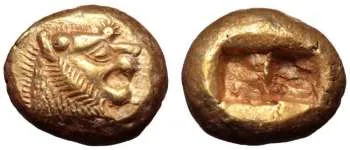 Photo: King Alyattes of Lydia, via www.wildwinds.com
The speed with which counterfeiting appeared reveals something crucial about human nature. Within a single generation of money's invention, someone had figured out how to exploit the gap between a coin's stated value and its material worth. The psychological insight was profound: money works because people believe it works, and belief can be manipulated.
That first counterfeiter understood what modern economists would later formalize: all currency is essentially a confidence game. The difference between real money and fake money is not inherent in the metal or paper, but in the authority that stands behind it. Counterfeiters have always been in the business of selling unauthorized confidence.
The Technology of Trust
Every advance in monetary technology has been matched by corresponding advances in monetary fraud. When Roman mints began adding specific weight standards and purity marks to their denarii, forgers developed techniques for creating coins that matched those specifications using bronze cores wrapped in silver. When medieval guilds introduced complex guild marks to verify the authenticity of trade tokens, counterfeiters learned to replicate those marks with remarkable precision.
The arms race was never really about technology — it was about psychology. Genuine coins derived their value from the reputation of the issuing authority. Counterfeit coins derived their value from their ability to impersonate that reputation convincingly enough to fool the next person in the transaction chain.
Consider the sophistication of Roman-era counterfeiting operations discovered by archaeologists in Gaul and Britain. These were not crude forgeries hammered out by individual criminals, but industrial-scale operations employing dozens of workers and sophisticated metallurgical techniques. Some counterfeit Roman coins were so well-made that modern scholars require spectrographic analysis to distinguish them from authentic issues.
The existence of such operations suggests that counterfeiting was not merely opportunistic crime but systematic economic warfare against imperial monetary policy.
The State's Response
Governments have always treated counterfeiting as something more serious than ordinary theft. The penalties were correspondingly severe: Roman law prescribed death for currency fraud, medieval English law mandated drawing and quartering for coin clippers, and colonial American statutes authorized hanging for paper money forgers.
The harsh punishments reflected an understanding that counterfeiting threatened more than individual transactions — it threatened the entire basis of economic exchange. If people lost confidence in the currency, trade would collapse, tax collection would become impossible, and the state itself might fail.
Yet the severity of anti-counterfeiting laws also reveals how persistent the problem was. Laws are not written to prohibit behaviors that never occur. The elaborate legal machinery developed to combat currency fraud suggests that such fraud was common enough to require systematic deterrence.
The Chinese approach was particularly instructive. Song Dynasty authorities not only executed counterfeiters but also posted their names and crimes in public places as warnings to others. The psychological strategy was clear: make the consequences of counterfeiting so visible and so terrible that the risk would outweigh any potential profit.
But the strategy failed because it misunderstood the psychology of the crime. Counterfeiters were not deterred by harsh punishments because they believed they would not be caught. The confidence that allowed them to fool others into accepting fake money also convinced them they could fool authorities into overlooking their crimes.
The Colonial Innovation
American colonial counterfeiting represented a new phase in the evolution of monetary fraud. For the first time, counterfeiters were working with paper currency rather than precious metals, and the technical barriers to entry were correspondingly lower. Anyone with a printing press and reasonable artistic skill could potentially produce convincing replicas of colonial notes.
The psychological dynamics, however, remained unchanged. Colonial paper money worked because merchants and farmers trusted the colonial governments that issued it. Counterfeiters exploited that trust by creating unauthorized claims on the same governmental authority.
Benjamin Franklin, who printed money for several colonial governments, became obsessed with anti-counterfeiting measures precisely because he understood how fragile paper currency confidence could be. His innovations — including specific paper types, complex border designs, and intentional spelling errors that counterfeiters would "correct" — were early examples of security through obscurity.
 Photo: Benjamin Franklin, via www.lihpao.com
Franklin's memoir describes the psychological pressure of printing money during a period when counterfeiting was rampant. Every authentic note he produced had to compete for credibility with unknown numbers of fraudulent copies. The value of his genuine currency depended not only on colonial governmental authority but on his ability to stay ahead of forgers who were studying his techniques.
The Economics of Deception
Counterfeiters have always faced a fundamental business problem: success destroys the market. If fake money becomes too common, people stop accepting any money that cannot be immediately verified. The counterfeiters' optimal strategy is to produce just enough fake currency to be profitable without producing so much that they undermine confidence in the currency system itself.
This creates a peculiar form of parasitic relationship. Counterfeiters need the monetary system to remain healthy enough to support their deception, but their deception inherently weakens the system they depend on. The most successful counterfeiters have always been those who understood this balance.
The career of William Chaloner, the 17th-century English counterfeiter, illustrates this dynamic. Chaloner did not simply forge coins — he studied the entire monetary system, identified its weaknesses, and then exploited those weaknesses while maintaining enough authentic-looking currency in circulation to preserve overall confidence. His operation was so sophisticated that he actually obtained a government position overseeing anti-counterfeiting efforts, allowing him to stay ahead of law enforcement while continuing his own criminal activities.
Chaloner's eventual downfall came not from the quality of his counterfeits but from the scale of his ambition. He became so successful that his fake coins began affecting the overall money supply, creating the very confidence crisis that would inevitably expose him.
The Psychological Infrastructure
What makes counterfeiting possible is not technical skill but social psychology. Currency works because people agree to pretend that particular objects have particular values. Counterfeiters succeed when they can convince others to extend that pretense to unauthorized objects.
The history of anti-counterfeiting measures is really a history of attempts to make currency more difficult to replicate. But replication was never the real challenge. The challenge was conviction — making fake money convincing enough that people would accept it without investigation.
This is why the most effective counterfeiters have often been those who understood human psychology better than metallurgy or printing. They succeeded not because their fakes were perfect, but because they understood the social situations in which people were most likely to accept imperfect money without close examination.
Market days, religious festivals, and military campaigns created environments where rapid transactions and unfamiliar faces made careful currency inspection impractical. Successful counterfeiters learned to time their operations to these social circumstances.
The Enduring Contest
Modern anti-counterfeiting technology — watermarks, security threads, color-changing inks — represents the latest phase in a contest that began with the first coins. The tools have evolved, but the fundamental dynamic remains unchanged: those who issue currency try to make it difficult to replicate, and those who counterfeit it try to replicate it anyway.
What has not changed is the psychological foundation of the entire system. Money still works because people trust it, and that trust is still vulnerable to exploitation by those clever enough to manufacture convincing imitations.
The three-thousand-year history of counterfeiting suggests that this contest will never be finally won by either side. As long as currency depends on confidence, there will be those who try to manufacture false confidence. As long as money has value, there will be those who try to create unauthorized money.
The real lesson of counterfeiting history is not about the ingenuity of criminals or the sophistication of security measures. It is about the fragility of the social agreements that make economic exchange possible. Every counterfeit coin or bill is a small test of those agreements — a question about whether the trust that underlies all monetary systems is justified.
Most of the time, it is. But the counterfeiters remind us that it doesn't have to be.