The Accidental Capital: Why the Cities That Were Never Meant to Matter Still Define the World
The city that was supposed to define a civilization usually didn't.
Antioch was supposed to be the great city of the eastern Mediterranean. Nanjing was supposed to anchor Chinese imperial power. Carthage was supposed to outlast Rome. The cities we actually remember — the ones that shaped the civilizations they nominally served — have a different kind of origin story, one characterized less by grand ambition than by practical compromise, geographic accident, and the particular durability that comes from having nothing to prove.
This is not a coincidence. It is a pattern, and it runs through the entire recorded history of urban development. Understanding it will change the way you look at the cities you visit — and it will almost certainly redirect your itinerary toward places that most travel guides treat as afterthoughts.
The Compromise Capital and Its Surprising Strength
Washington D.C. was, from its first moment, nobody's first choice. The Constitutional Convention of 1787 produced a federal government that needed a home, and the question of where that home would be located immediately exposed the fault lines of the new republic. Northern states wanted the capital in the North. Southern states wanted it in the South. The compromise — a purpose-built city on the Potomac, carved from land contributed by Virginia and Maryland — satisfied no one in particular, which is precisely why it was acceptable to everyone.
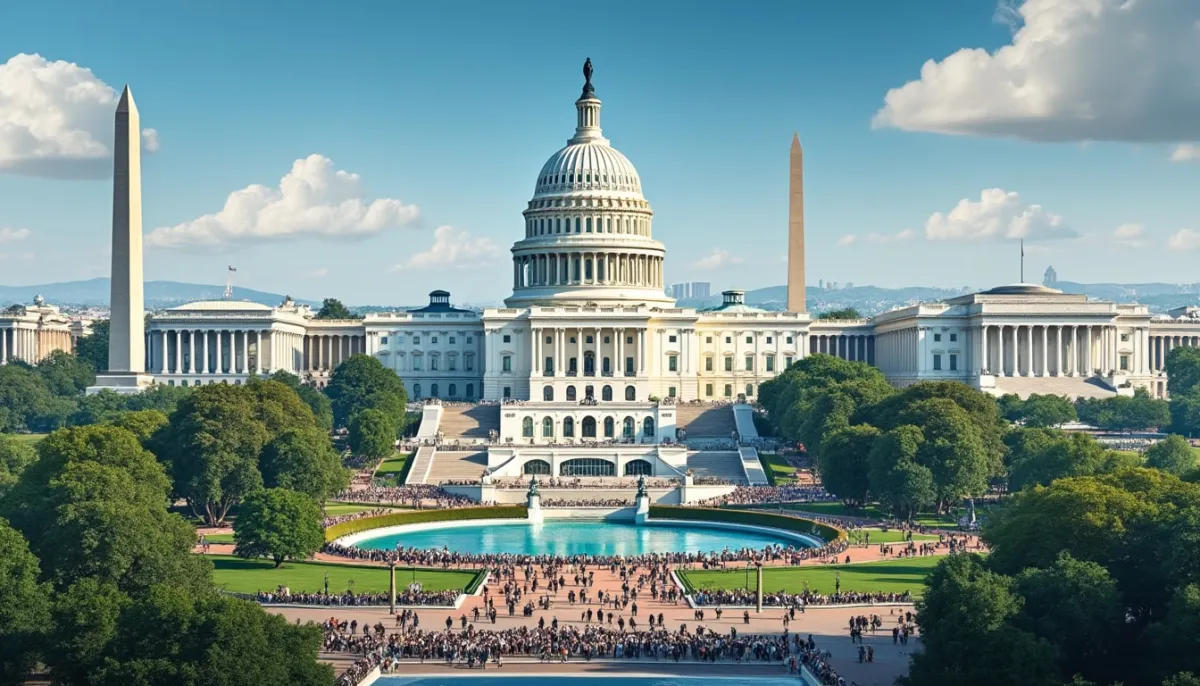 Photo: Washington D.C., via washingtondcview.com
The city that emerged from this arrangement spent its first decades being mocked by European visitors as a swampy, half-finished embarrassment. Charles Dickens, visiting in 1842, described it with characteristic precision as a place of "spacious avenues that begin in nothing and lead nowhere." The grand plan existed. The city, for a considerable time, did not.
And yet. The very qualities that made Washington seem weak in its early years — its lack of pre-existing commercial interests, its absence of an entrenched civic elite, its identity as a governmental construct rather than an organic city — eventually became sources of institutional resilience. It was a capital that belonged to no region, which meant it could, at least in theory, represent all of them. The compromise that produced it turned out to be a more stable foundation than the confident ambitions of cities that had been designed to dominate.
The American traveler who wants to understand this dynamic in its most visible form should, at some point, stand in the Mall and contemplate the fact that the city surrounding them was built to be a symbol before it was built to be a city. The monument preceded the metropolis. That reversal of the usual sequence is what makes Washington legible as a capital — and what makes it slightly uncanny as a place to actually live.
Constantinople: The Strategic Gamble That Lasted a Millennium
When Constantine decided, in 330 CE, to relocate the administrative center of the Roman Empire to the ancient Greek city of Byzantium, he was not making a cultural statement. He was solving a military problem. The eastern frontier was where the real threats were. The old city of Rome, magnificent and symbolically irreplaceable, was also geographically inconvenient for a ruler who needed to be closer to the action.
Byzantium — rechristened Constantinople — occupied a peninsula at the intersection of Europe and Asia, commanding the straits that connected the Black Sea to the Mediterranean. It was, from a purely defensive standpoint, one of the most advantageous sites on the continent. It was also a city that had never been particularly important, which meant it had no existing power structure to accommodate, no senatorial aristocracy to negotiate with, no centuries of urban politics to navigate.
Constantine built his new capital essentially from scratch, importing population, importing relics, importing the physical substance of Roman prestige in the form of columns, statues, and monuments stripped from other cities. The result was a city that was simultaneously ancient and new — a place that wore the symbols of Roman continuity while being, in its actual structure, a fresh political creation.
Constantinople survived the western Roman Empire by a thousand years. It survived because its geography was nearly impregnable, because its institutional structure was not encumbered by the accumulated dysfunction of Rome's older political traditions, and because the very artificiality of its founding gave successive rulers the freedom to reinvent it as circumstances required. The city that was chosen for convenience became, through centuries of reinvention, the most sophisticated urban center in the medieval world.
For the traveler willing to make the journey to Istanbul — which is what Constantinople became after 1453, and which remains one of the most historically dense cities on Earth — the physical evidence of this layered history is everywhere. The Hagia Sophia alone contains more civilizational transitions than most countries. But the neighborhoods away from the major monuments — Balat, Fener, the streets along the old Theodosian walls — offer something the famous sites cannot: the texture of a city that has been continuously inhabited, continuously adapted, and continuously reinvented across seventeen centuries.
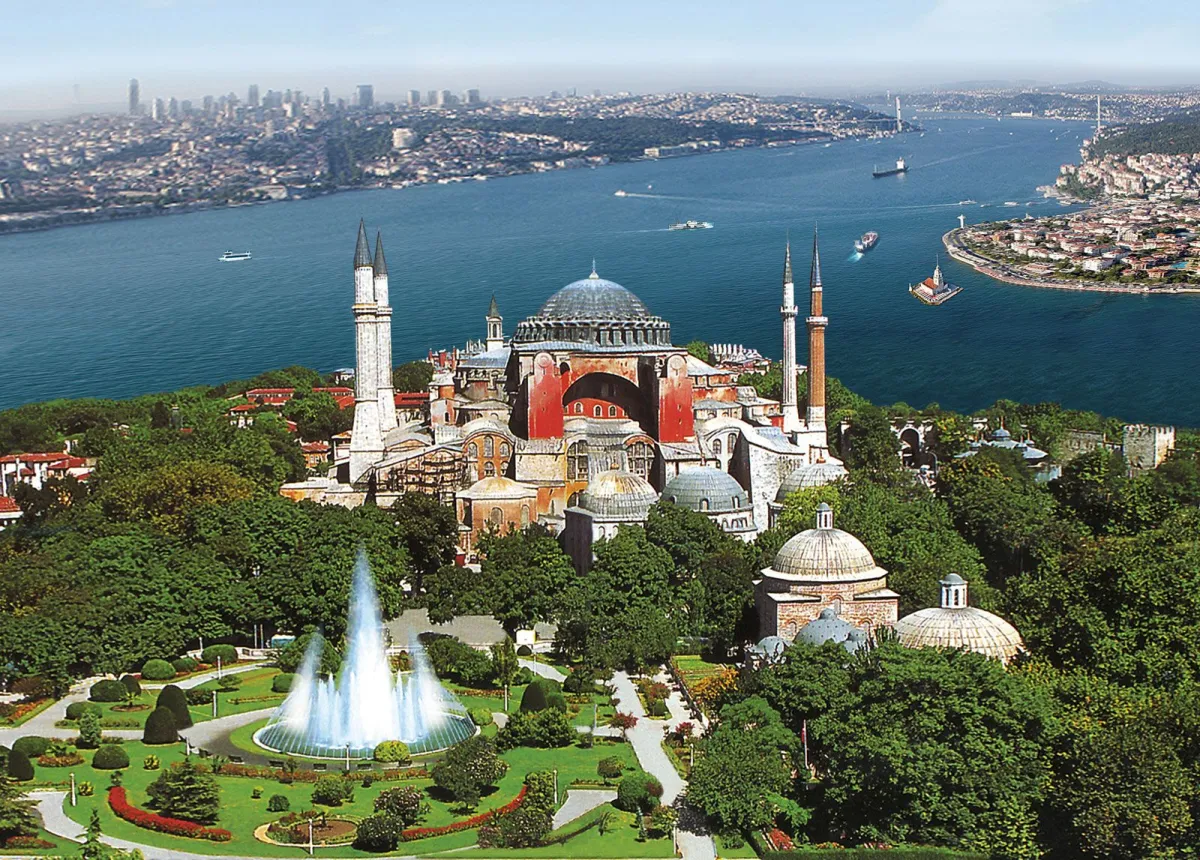 Photo: Hagia Sophia, via cdn.britannica.com
Edo and the Accident of Administrative Convenience
In 1590, when the warlord Tokugawa Ieyasu was assigned the Kanto plain as his domain by the ruler Toyotomi Hideyoshi, it was widely understood to be a demotion. The Kanto was distant, underdeveloped, and dominated by a marshy fishing village called Edo. Hideyoshi, who controlled the culturally prestigious cities of Kyoto and Osaka, evidently calculated that the assignment would keep a powerful rival occupied with the unglamorous work of frontier development.
The calculation was catastrophically wrong. Ieyasu spent the next decade transforming Edo through engineering, drainage, and administrative organization into the functional capital of the Tokugawa shogunate that would govern Japan for two and a half centuries. By the mid-seventeenth century, Edo was already one of the largest cities in the world. By the eighteenth century, with a population approaching one million, it was arguably the largest.
The city that became Tokyo was built, in other words, on the site of an administrative afterthought, by a man who had been sent there precisely because the location seemed to offer limited opportunity. The geographic constraints that made Edo seem unpromising — its distance from established power centers, the necessity of large-scale engineering to make it habitable — turned out to be productive constraints. They forced a kind of systematic urban planning that the older, organically developed cities of Japan had never required.
The Second City as First Destination
The pattern these cities share — chosen for convenience or compromise, shaped by constraint, ultimately more durable than the obvious alternatives — has a practical implication for the historically curious traveler that goes beyond mere intellectual interest.
The cities that were designed to be great, that were built as expressions of confident civilizational ambition, tend to be the cities that appear first in every guidebook. They are magnificent, and they deserve their reputations. But they are also the cities where the historical texture has been most thoroughly managed — curated, restored, explained, and surrounded by the infrastructure of mass tourism.
The second cities — the ones that grew from compromise or accident, that were never quite the center of things — often preserve something that the official capitals have lost. In Poland, Kraków retains the architectural and intellectual character of a city that was the capital before Warsaw, and that survived the twentieth century with its historic center largely intact precisely because it was no longer important enough to be a primary military target. In Japan, Kanazawa — which accumulated cultural wealth during the Edo period as a domain capital far from the shogunate's direct oversight — contains some of the finest traditional arts and architecture in the country, known primarily to travelers who have already exhausted Kyoto.
In Turkey, cities like Bursa and Edirne — both of which served as Ottoman capitals before Constantinople fell — offer the experience of Ottoman history without the crowds that make Istanbul's major sites difficult to appreciate at anything approaching a contemplative pace.
What the Accidental Capital Teaches
The deeper lesson of the accidental capital is not really about urban planning or geography. It is about the relationship between constraint and creativity, between the absence of grand design and the possibility of genuine adaptation.
The cities that were supposed to be great had everything arranged for them in advance. The cities that became great had to solve problems. The problem-solving left traces — in the street patterns, in the architectural compromises, in the layered evidence of successive adaptations — that the purpose-built city, with its grand avenues leading everywhere at once, does not contain.
Human beings have been making this particular mistake for five thousand years: assuming that the place designed for greatness will achieve it, and that the compromise, the afterthought, the strategic gamble will remain what it started as. History declines to confirm this assumption. The traveler who internalizes that fact will find, consistently, that the most interesting place in any region is rarely the one that was always supposed to be.