The Toll Collectors Who Became the Road: Five Thousand Years of Middlemen Taking Over

Photo by Photo by Wwwwww Lu on Unsplash on Unsplash
Consider the geography of a transaction. There is a seller. There is a buyer. Between them, there is distance — physical, linguistic, cultural, or some combination of all three. The person who bridges that distance does not produce the goods being traded. They do not consume them. They simply move them, translate them, and make the exchange possible. In theory, they are servants of the transaction. In practice, they are its masters.
This is one of the most reliable patterns in economic history, and it has been repeating since the first Bronze Age merchant realized that the people who needed tin and the people who had it were separated by a sea neither could cross alone. The history of trade is, in substantial part, a history of intermediaries who began as connectors and ended as controllers — and of the empires, merchants, and consumers who never quite understood what had happened to them until it was too late.
Human psychology has not changed in five thousand years. The cognitive tendency to undervalue the infrastructure of exchange — to focus on what is being traded rather than who is enabling the trade — is as consistent as any behavioral pattern the historical record contains. The middleman's power has always depended on this blind spot.
The Phoenician Proof of Concept
The Phoenicians did not control the timber of Lebanon, though they harvested it. They did not control the silver of Iberia, though they traded it. They did not control the grain of Egypt, though they moved it. What they controlled was the connection between every pair of parties who needed something the other had — and the maritime infrastructure, the navigational knowledge, and the commercial relationships that made those connections possible.
At their height, Phoenician trading networks stretched from the Levantine coast to the Atlantic shores of modern Morocco and Portugal. They established Carthage not as a colony in the conventional sense but as a waystation — a node in a network. The city's extraordinary subsequent power derived not from agricultural surplus or mineral wealth but from its position as the place through which Mediterranean commerce had to pass.
Rome eventually destroyed Carthage, but the destruction solved less than it appeared to. The commercial functions Carthage performed did not disappear; they migrated to other intermediaries. The Eastern Mediterranean's trading networks continued operating under different management. The goods kept moving. The toll collectors changed, but the toll persisted.
Samarkand and the Oasis Principle
The Silk Road, as a concept, tends to conjure images of Chinese silk moving westward and Roman gold moving east, with the trade routes themselves as neutral conduits. The reality was considerably more complex and considerably more interesting.
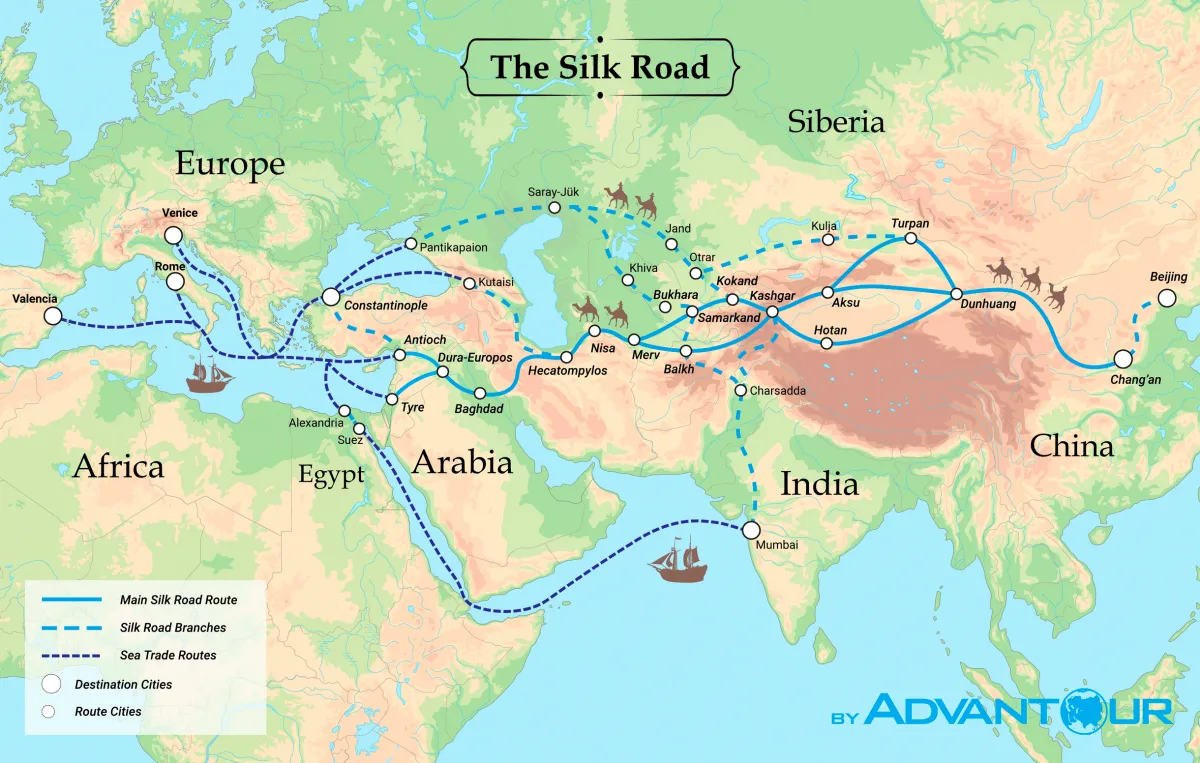 Photo: Silk Road, via www.advantour.com
The oasis cities of Central Asia — Samarkand, Bukhara, Merv, Kashgar — were not rest stops on a through-route. They were the route. The merchants who controlled these cities controlled the information asymmetries that made long-distance trade profitable: they knew what was available, what was needed, what the going price was in markets a thousand miles away that their trading partners had never visited. This knowledge was the actual commodity, more valuable than the silk or the spices or the glassware moving alongside it.
Sogdian merchants, operating out of Samarkand from roughly the fourth through eighth centuries, built commercial networks of remarkable sophistication. Their letters — a cache was discovered in a watchtower in the early twentieth century — reveal merchants managing credit, partnerships, and information flows across distances that would challenge modern logistics. They were not simply moving goods. They were operating the information infrastructure that made the entire Silk Road system function.
When the Tang dynasty recruited Sogdian merchants as commercial intermediaries, it was acknowledging something that every empire along the Silk Road eventually had to acknowledge: you could not simply replicate the network. The network was the people. The relationships, the knowledge, the trust — these were not transferable assets. They were the middlemen themselves.
The VOC's Local Brokers and the Lesson Never Learned
The Dutch East India Company — the VOC — is often presented as a story of European commercial dominance over Asian trade networks. This framing obscures something more instructive about how commercial power actually works.
The VOC could not operate its Asian trading empire without local intermediaries: the Chinese merchants who controlled retail distribution in Southeast Asia, the local rulers whose cooperation made port access possible, the brokers who translated not just languages but commercial customs, credit systems, and social relationships that Dutch factors could not navigate alone. These intermediaries were, in the company's accounting, costs to be minimized. In practice, they were the mechanism through which the VOC's paper authority was converted into actual commerce.
As the VOC's direct management capacity weakened in the late seventeenth and eighteenth centuries, these intermediaries did not simply fill the vacuum — they had, in many cases, already created parallel structures that the VOC's presence had obscured rather than replaced. The Chinese merchant networks that the company had used as distribution infrastructure were simultaneously using the VOC as a framework within which to expand their own commercial reach. The intermediary and the principal had been building different things with the same transactions.
The Mechanism Behind the Pattern
The consistency of this pattern across such different contexts — Bronze Age Levant, medieval Central Asia, early modern Southeast Asia — suggests something more fundamental than coincidence. It reflects a structural feature of how exchange works when the parties to a transaction cannot reach each other directly.
The intermediary's power derives from information asymmetry and relationship capital. They know what each party needs, what each party has, and what each party will accept. They have invested in the trust relationships that make transactions possible. These are not incidental features of their role; they are the role. And they are not transferable to whoever nominally controls the trade route, the port, or the company charter.
Every empire that tried to eliminate its middlemen discovered this. The Venetians who attempted to bypass Levantine traders found that the knowledge those traders carried could not be requisitioned. The Portuguese who tried to replace Arab merchants in the Indian Ocean trade discovered that the commercial relationships those merchants maintained were not simply functions of geography. You could control a strait without controlling the trade that moved through it, if the people who knew how to move that trade had options.
The historical lesson, available to any civilization willing to read it, is that the most durable commercial power has never resided in the goods themselves, or even in the routes along which they travel. It has resided in the indispensable position between. Five thousand years of merchants understood this intuitively. The empires that employed them never quite did.