Sacred Substitutions: How Medieval Christianity Conquered Europe by Stealing Its Gods

The Art of Holy Theft
In 597 CE, Pope Gregory the Great sent a letter to Abbot Mellitus that would define Christian expansion strategy for the next thousand years. Rather than destroying pagan temples, Gregory instructed, convert them into churches. Rather than eliminating pagan festivals, transform them into Christian celebrations. Rather than confronting local religious traditions directly, absorb them. "For it is certainly impossible," the Pope wrote, "to efface everything at once from their obdurate minds."
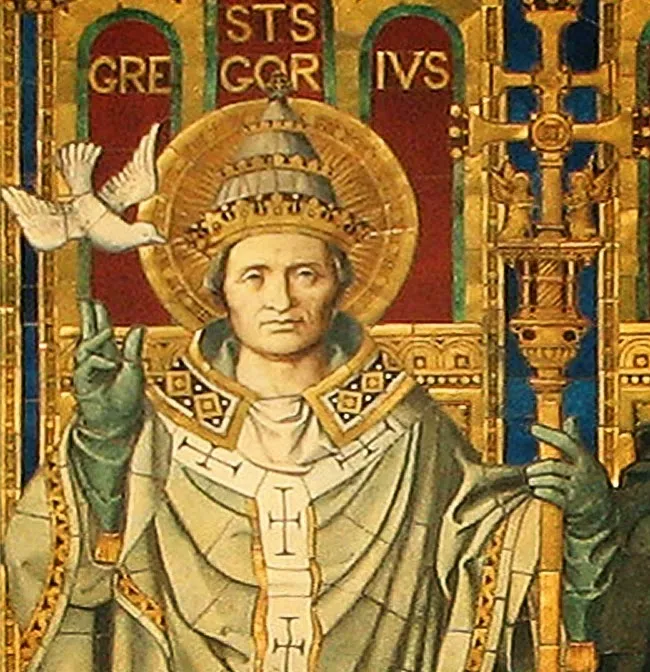 Photo: Pope Gregory the Great, via 3.bp.blogspot.com
This wasn't theological compromise—it was strategic genius. Gregory had identified a fundamental truth about human psychology that modern institutions still struggle to understand: people will abandon familiar practices only if you give them familiar-seeming replacements. The most effective way to eliminate opposition isn't to destroy it, but to make it indistinguishable from compliance.
The Franchise Model of Sanctity
The medieval Church operated like a spiritual franchise system, with saints serving as local representatives of universal Christian authority. When missionaries encountered a Celtic goddess associated with healing springs, they didn't drain the springs or forbid the rituals. Instead, they assigned a Christian saint to the location, declared the healing powers a miracle of Christian faith, and continued collecting offerings—now for the Church rather than pagan priests.
Saint Brigid of Ireland perfectly exemplifies this strategy. Her feast day falls on February 1st, exactly coinciding with Imbolc, the Celtic festival celebrating the goddess Brigit. Her symbols—fire, water, and craftsmanship—mirror those of her pagan predecessor. Even her miracles echo pre-Christian Irish mythology. The Church didn't eliminate the goddess Brigit; it simply gave her a Christian makeover and called her a saint.
 Photo: Saint Brigid of Ireland, via findthesaint.com
This pattern repeated across Europe with mechanical precision. Thor became Saint Olaf in Scandinavia. Celtic tree spirits became Saint Columba. Roman household gods became patron saints of trades and neighborhoods. The Church created an entire celestial bureaucracy that mirrored the spiritual landscape it was replacing.
The Psychology of Seamless Transition
What made this strategy so effective wasn't just its administrative convenience—it was its psychological sophistication. The Church understood that people don't just practice religion; they inhabit it. Religious beliefs shape daily routines, seasonal celebrations, and responses to crisis. Asking people to abandon these patterns entirely would have triggered massive psychological resistance.
By preserving the external forms of familiar practices while gradually shifting their theological content, the Church allowed populations to feel like they were maintaining their traditions while actually adopting entirely new ones. A farmer who had always left grain offerings at a sacred grove could continue the practice—he was now honoring Saint Isidore, patron of agriculture, rather than forest spirits. The action remained the same, but its meaning had been revolutionized.
Modern psychological research on belief change confirms what medieval Church strategists intuited: people accept new ideas most readily when those ideas can be integrated into existing mental frameworks. The saints system provided exactly this kind of integration, creating theological continuity where actual historical continuity had been broken.
The Corporate Takeover Strategy
What the Church accomplished in medieval Europe resembles nothing so much as a modern corporate acquisition strategy. When a large corporation buys a smaller competitor, it rarely shuts down the acquired company immediately. Instead, it typically maintains the familiar brand name and local management while gradually integrating operations and redirecting profits to corporate headquarters.
The Church applied this same logic to spiritual conquest. Local religious practices continued under familiar names with familiar rituals, but the ultimate authority and the flow of resources shifted to Rome. Pagan priests became Christian clergy. Sacred sites became Church property. Traditional festivals became Christian holy days. The spiritual economy remained largely unchanged at the local level while being completely reorganized at the institutional level.
This strategy proved far more effective than direct confrontation. When Roman emperors tried to eliminate Christianity through persecution, they only strengthened Christian resolve and created martyrs who attracted new converts. When the Church tried to eliminate paganism through absorption rather than destruction, resistance largely evaporated because people couldn't identify exactly what they were supposed to resist.
American Echoes of Ancient Strategies
The same psychological mechanisms that enabled medieval Christian expansion operate in contemporary American culture. When Walmart enters a small town, it doesn't immediately shut down local businesses. Instead, it offers the same products at lower prices while gradually making local competition unsustainable. The familiar shopping experience continues, but the economic power structure transforms completely.
Similarly, when tech companies acquire startups, they typically promise to maintain the startup's innovative culture while providing resources for growth. Users continue accessing familiar services through familiar interfaces while their data and attention are redirected toward the acquiring company's broader strategic goals.
These modern examples demonstrate the enduring effectiveness of absorption strategies across different domains. Whether the goal is religious conversion, economic consolidation, or technological integration, the basic psychological principle remains constant: people accept change most readily when it doesn't feel like change.
The Limits of Appropriation
However, the Church's saint-substitution strategy also revealed the limitations of absorption-based expansion. By preserving so many pagan elements within Christian frameworks, the Church created opportunities for syncretism that sometimes undermined orthodox doctrine. Folk Christianity in many regions retained distinctly non-Christian characteristics that persisted for centuries after formal conversion.
In Ireland, for example, Saint Brigid acquired attributes that had more to do with Celtic goddess traditions than Christian theology. In Scandinavia, Christ himself was sometimes depicted in ways that echoed Norse mythology rather than Mediterranean Christianity. The Church had successfully eliminated organized pagan resistance, but it had also created forms of Christianity that were barely recognizable to Roman theologians.
This suggests an important limitation of appropriation strategies: they work best when the absorbing institution can maintain clear control over how borrowed elements are interpreted and used. When that control weakens, appropriated symbols can become vehicles for the very opposition they were designed to neutralize.
Modern Lessons in Institutional Absorption
The Church's medieval expansion strategy offers valuable insights for contemporary institutions trying to manage cultural change. Universities facing student protests often respond by creating new programs or departments that appear to address protesters' concerns while channeling their energy into institutional rather than revolutionary directions. Corporations facing environmental criticism launch green initiatives that preserve their core business models while adopting the language of sustainability.
These modern applications of absorption strategy work for the same psychological reasons that medieval saint-substitution worked: they allow people to feel like their concerns are being addressed without requiring fundamental changes to existing power structures. The key is ensuring that symbolic concessions don't become platforms for more substantial challenges to institutional authority.
The Eternal Return of Appropriation
What the medieval Church accomplished through saint-substitution continues to shape how institutions manage resistance and change. From political parties adopting opposition talking points to corporations embracing social justice language, the basic strategy remains remarkably consistent: when you can't beat them, rebrand them.
This pattern suggests something profound about human psychology and institutional survival. People need to feel connected to traditions and symbols that provide meaning and identity. Institutions that can successfully appropriate and redirect those symbols gain enormous power over hearts and minds. But institutions that rely too heavily on appropriation risk losing control over the very symbols they've borrowed.
The medieval Church's saint-making machinery represents one of history's most successful experiments in large-scale cultural transformation. By understanding how it worked—and why it sometimes failed—we can better recognize similar dynamics in our own time. Every time an institution claims to represent values it once opposed, every time a movement's symbols are adopted by its former enemies, the ghost of Saint Brigid is smiling somewhere, knowing that the ancient art of holy theft continues to shape the modern world.