The Stone That Remembers Who Carried It: Infrastructure, Labor, and the Resentment That Outlasts Monuments
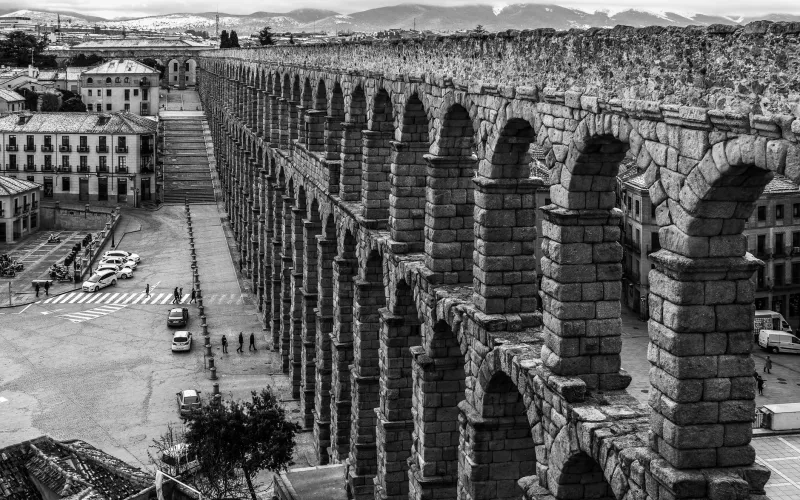
The Pont du Gard in southern France is, by any reasonable measure, one of the most beautiful structures human beings have ever produced. It spans the Gardon River in three elegant tiers, carries water across a valley on arches that have stood for nearly two thousand years, and receives roughly a million visitors annually. Photographs of it appear in travel magazines, architecture textbooks, and the kind of coffee-table books that sit on shelves in American living rooms without being opened. What those photographs do not show—what they cannot show—is the social history of the communities that built it, maintained it, and were periodically conscripted to repair it across the centuries of Roman imperial administration in Gaul.
This is not an accident of photography. It is a habit of mind that runs through the entire recorded history of monumental infrastructure: the tendency to separate the monument from the conditions of its creation, to admire the product while declining to examine the process.
The Calculation Behind the Stone
Ancient states did not build infrastructure out of civic generosity. They built it because infrastructure extended state power, and extending state power was the primary business of ancient states. Roman roads moved armies. Aqueducts sustained urban populations that paid taxes and provided military recruits. The Incan road network—roughly 25,000 miles of engineered paths crossing some of the most inhospitable terrain on Earth—was, before anything else, a military and administrative system. The fact that merchants and pilgrims also used it was a secondary benefit, not the primary motivation.
The labor required to build these systems was extracted through mechanisms that ranged from outright slavery to various forms of corvée obligation, in which subject populations owed the state a certain number of days of physical labor per year as a form of taxation. The Egyptian corvée that built and maintained irrigation infrastructure along the Nile was not, as it is sometimes romanticized, a community coming together to manage shared resources. It was a labor tax, administered by an imperial bureaucracy, enforced by officials who had the authority to compel compliance.
The workers who built the Pont du Gard were not Roman engineers. They were local Gauls, some of them skilled craftsmen, many of them not, working under Roman supervision on a project that would primarily benefit the Roman colonial city of Nîmes. The water the aqueduct delivered would flow to the fountains, bathhouses, and private residences of a city whose wealthiest residents were Roman citizens or their clients. The communities that provided the labor lived downstream of that social arrangement in ways that were not metaphorical.
What the Workers Knew
Human psychology has not changed in five thousand years. The worker conscripted to haul stone for an imperial project in the second century CE understood something that the emperor in Rome did not need to understand: that the labor being extracted was finite, that the body doing the extracting could be broken, and that the monument being built would serve interests that were not the worker's own. This knowledge did not require literacy or philosophical sophistication. It required only the experience of being used.
The historical record of ancient labor is fragmentary, because ancient states were not interested in preserving the perspectives of the people who built their infrastructure. But what survives is suggestive. Egyptian papyri from the New Kingdom period document workers abandoning state construction projects, sometimes en masse, in response to inadequate rations or delayed payment. The strikes at Deir el-Medina in the twelfth century BCE—among the earliest recorded labor actions in human history—were carried out by workers building the royal tombs in the Valley of the Kings, men who were, by the standards of ancient Egypt, relatively well-compensated and relatively free. Even they reached a threshold.
The Roman Empire's infrastructure workforce included slaves, freedmen, soldiers on construction assignment, and conscripted provincials. The soldiers, interestingly, were among the most productive and the most resentful. Military construction duty was unpopular precisely because soldiers understood that they were being used as a labor resource rather than a fighting force, and because the distinction mattered to their sense of what they were owed.
The Resentment That Outlasts the Road
Monuments are durable. So is social memory. The communities that provided labor for imperial infrastructure projects did not forget the terms of that exchange simply because the infrastructure was impressive. In Roman Britain, the road network that modern historians celebrate as an administrative achievement was, from the perspective of the communities that maintained it, a permanent obligation. Roads required constant repair. Repair required labor. Labor was extracted from the people who lived near the roads, regardless of whether those people used the roads or benefited from the trade they facilitated.
This pattern—in which the communities closest to infrastructure bear the highest costs and receive the most ambiguous benefits—is not a feature of ancient administration. It is a feature of infrastructure development across all of recorded history. The American railroad expansion of the nineteenth century displaced, exploited, and in many cases destroyed the communities it passed through while enriching investors and urban centers at considerable remove. The Chinese laborers who built the transcontinental railroad's western section were paid less than their white counterparts, housed in worse conditions, assigned the most dangerous work, and excluded from the commemorative photograph taken at Promontory Summit in 1869 when the last spike was driven.
The monument was completed. The people who built it were not invited to the celebration. This, too, is a pattern that the historical record documents with a consistency that should be instructive.
The Civic Pride That Concealed the Arithmetic
Ancient states were sophisticated enough to understand that naked extraction produces resistance, and that resistance is expensive to suppress. The ideological apparatus surrounding monumental infrastructure—the religious significance of temples, the civic identity attached to aqueducts, the military pride associated with road networks—was not incidental to these projects. It was essential to their management.
When Augustus rebuilt Rome in marble, the civic pride his building program generated was real. Romans genuinely identified with the grandeur of their city in ways that made them more willing to tolerate the costs of maintaining it. This is not false consciousness in any simple sense. It is the predictable outcome of a sustained effort to make people feel that the monuments belonged to them, rather than to the class whose interests the monuments primarily served.
The workers who built those monuments understood the arithmetic differently. They understood it in their bodies, in the years taken from their lives, in the wages that did not quite cover the cost of the labor they had provided. The stone remembers who carried it, even when the histories written by the beneficiaries prefer to discuss the architecture.