The Man in the Middle: How Translators Have Always Held Empires Hostage

There is a particular kind of helplessness that even the most powerful men in history have been unable to escape. A general can command armies. A king can confiscate estates. An emperor can rearrange the borders of the known world. But place any of them before a man who speaks a language they do not understand, and they are suddenly dependent — entirely, uncomfortably — on whoever is standing between them and the words.
This is not a modern problem. It is one of the oldest institutional vulnerabilities in the history of organized power, and the solutions civilizations have reached for, across five thousand years, reveal something consistent and uncomfortable about human psychology: we have never solved the problem of trusting someone who understands things we cannot.
The Assyrians Knew First
The Assyrian Empire, which dominated the ancient Near East from roughly the ninth century through the seventh century BCE, was among the first states to confront translation as a strategic liability at scale. Its administrators corresponded in Aramaic across territories where dozens of local languages were spoken, and the scribes who mediated those communications occupied a peculiar position in the imperial hierarchy — indispensable, trusted by necessity, and watched with the particular suspicion that necessity always generates.
 Photo: Assyrian Empire, via german.ffucleanroom.com
Assyrian records reveal a bureaucratic reflex that would be repeated by virtually every subsequent empire: the attempt to solve the interpreter problem through redundancy. Where possible, important negotiations were conducted with multiple translators present, each theoretically able to catch the errors — or the manipulations — of the others. It was an expensive solution, and it worked only as long as the translators had not coordinated with one another. Which, of course, they sometimes had.
The deeper problem was structural. An empire that needed interpreters was an empire that had already exceeded the boundaries of its own comprehension. Expansion and linguistic dependency were the same phenomenon. Every mile gained beyond the home tongue was a mile ceded to the man in the middle.
La Malinche and the Weight of Words
No figure in the history of translation better illustrates the psychological complexity of the interpreter's position than the woman the Spanish called La Malinche — born Malintzin, a Nahua noblewoman who became the primary translator for Hernán Cortés during the conquest of Mexico between 1519 and 1521.
The historical record, complicated by centuries of Mexican national mythology, makes it difficult to reconstruct her intentions with any precision. What is clear is that Cortés, commanding a force that was absurdly outnumbered in a territory he did not understand, was functionally blind without her. She did not merely translate words. She interpreted context, navigated political alliances among the peoples Cortés was attempting to either recruit or subdue, and mediated between two civilizations that had no prior framework for understanding each other.
The conquistadors, to their credit as strategists if not as human beings, understood the leverage this created — and they understood it ran in both directions. La Malinche's value to Cortés was precisely what made her dangerous to him, and the psychological calculus of that relationship — dependence generating suspicion generating closer surveillance generating greater dependence — is a pattern any modern organization would recognize instantly.
It is worth noting that Cortés never fully solved this problem. He managed it. The distinction matters.
The Ottoman Solution: Institutionalize the Vulnerability
The Ottoman Empire, which at its height administered territories stretching from Hungary to the Persian Gulf, developed what may be the most sophisticated institutional response to the interpreter problem in pre-modern history. Rather than treating translation as an ad hoc necessity, the Ottomans formalized it into a distinct professional class — the dragomans, a hereditary caste of translators drawn primarily from Greek Christian families of Constantinople who served the Sublime Porte for generations.
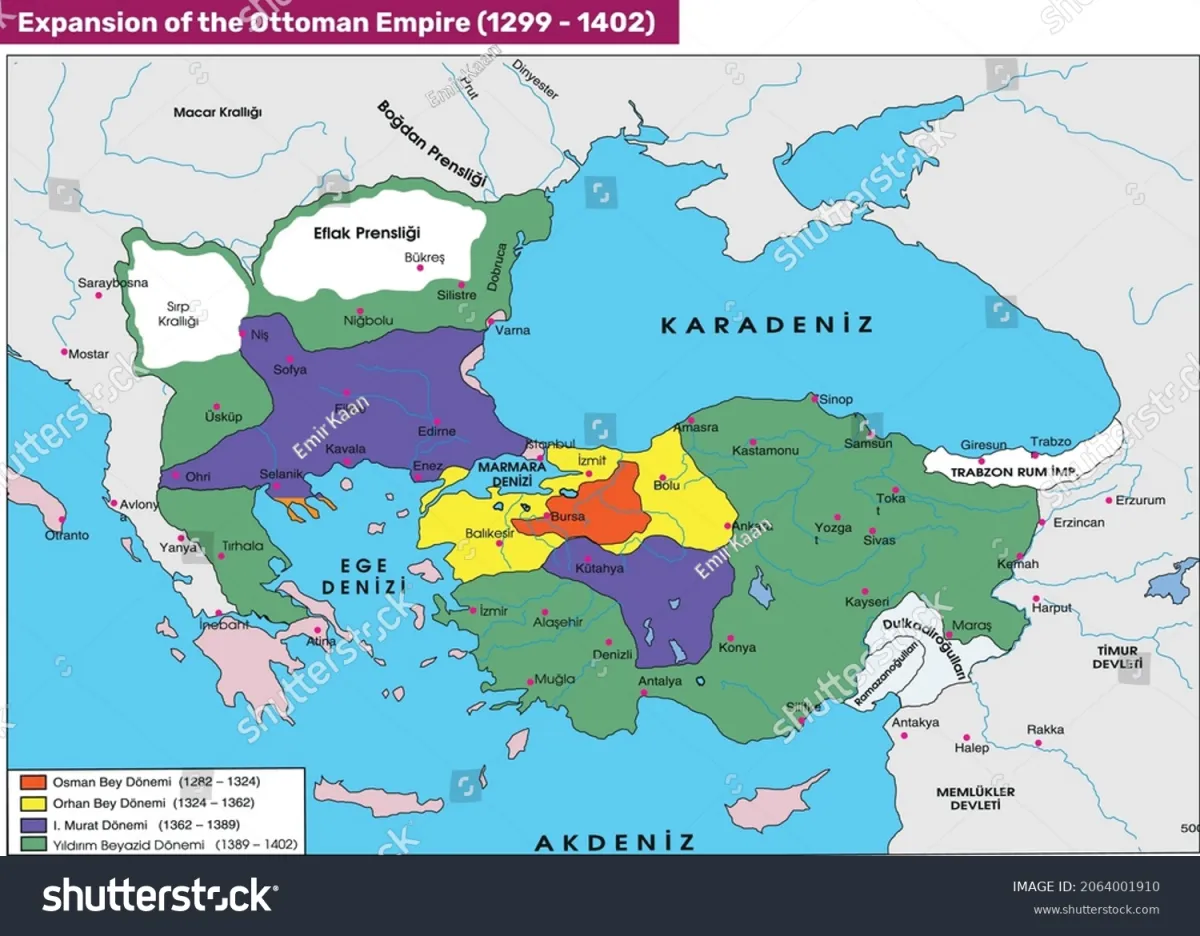 Photo: Ottoman Empire, via www.shutterstock.com
The logic was elegant in its cynicism. By making translation a hereditary profession, the Ottomans created translators whose loyalty was structural rather than incidental. A dragoman family's wealth, status, and physical safety depended entirely on continued Ottoman favor. They had no foreign patron to run to, no alternative empire to defect toward, no ideology that superseded their institutional position.
And yet the system still produced spectacular betrayals. The very intimacy that made dragomans valuable — their fluency in foreign courts, their relationships with European ambassadors, their deep knowledge of Ottoman internal politics — also made them extraordinarily useful to the empire's enemies. Several of the most damaging intelligence failures in Ottoman diplomatic history can be traced directly to dragomans who had quietly developed secondary relationships with the powers they were supposed to be translating against.
The Ottomans responded by doing what every empire does when a security solution fails: they added more layers. More oversight. More redundancy. More surveillance. The problem did not go away. It simply became more expensive.
What the Pattern Reveals
The recurring institutional response to the interpreter problem — redundancy, surveillance, formalized dependency, hereditary loyalty structures — tells us something important about how human beings manage trust under conditions of irreducible uncertainty.
We do not, as a species, tolerate the sensation of being unable to verify the thing we most need to know. When we cannot eliminate that uncertainty directly, we construct elaborate systems designed to make betrayal costly rather than impossible. The Assyrians added translators. The Spanish kept La Malinche physically close and politically dependent. The Ottomans built families whose entire existence was collateral.
None of these solutions addressed the root condition. They managed the anxiety while leaving the vulnerability intact.
This is, it should be said, exactly what modern organizations do with their own information asymmetries. The consultant who understands your systems better than you do. The analyst who reads the data you cannot interpret. The communications director who decides which version of your words reaches the public. The interpreter problem did not end with the age of empires. It metastasized into every institution that has ever depended on specialized knowledge — which is to say, every institution that has ever existed.
The Lesson That Never Gets Learned
The most striking thing about five thousand years of the interpreter problem is not that empires kept encountering it. It is that they kept being surprised by it.
Every new empire that crossed a language border seemed to discover the translator's leverage as though it were a novel complication rather than the most predictable consequence of expansion. The psychological mechanism is consistent: the institution's need for the interpreter is so urgent that acknowledging the interpreter's power feels like an admission the institution cannot afford to make. So the admission is deferred. The dependency is managed rather than examined. And the crisis, when it comes, is treated as a betrayal rather than as the inevitable outcome of a structural choice made long before.
The person who controls the message controls the meaning. This was true in the cuneiform archives of Nineveh. It was true in the smoking ruins of Tenochtitlan. It is true in every boardroom, every diplomatic channel, and every institution that has ever needed someone to stand between itself and a world it could not fully read.
History does not offer a solution to this problem. It offers only the consistent record of how human beings have refused to face it squarely — and what that refusal has cost them.